WISCIENCE Community-Based Learning (CBL) Framework
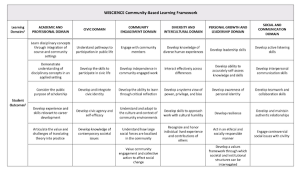
The Community-Based Learning (CBL) Framework is a resource meant to provide a shared language for instructors and students in community-based learning courses. It articulates knowledge, skills, and values that actively span the boundary between the university and community, allowing meaningful participation in public life. It provides a lens through which to approach large, complex issues, by breaking issues into smaller, more approachable parts.
Download the CBL Framework
Available as a PDF or Word Doc.
While this framework was developed in a STEM context, it is meant to be useful across disciplines. None of the framework’s components are discipline-specific, giving them broad applicability.
This framework supports the community-engaged courses and programs at WISCIENCE, and it is just one of many approaches to community-based teaching and learning. For more on these topics, the Morgridge Center for Public Service is a fantastic resource—they coordinate university-wide efforts and have many programs that help connect students, faculty, and community members.
The Community-Based Learning Framework is divided into six broad learning domains (categories) with several student outcomes nested in each one. The domains are:
- Academic and Professional Domain
- Civic Domain
- Community Engagement Domain
- Diversity and Intercultural Domain
- Personal Growth and Leadership Domain
- Social and Communication Domain
For students, the CBL framework can provide:
- Development of highly transferrable knowledge and skills.
- Identification of skills that bridge disciplines (i.e., communication, leadership, and intercultural skills).
- Knowledge and skills that students are able to include on a resume or talk about in an interview.
For instructors, the CBL framework can provide:
- Identification of CBL-related student outcomes that are frequently already part of a course but may not be clearly articulated to students.
- A resource to guide learning outcomes development and course design.
The framework is intended to be flexible and adaptable—it is not prescriptive or all-encompassing. It is NOT meant to:
- Describe what happens in every CBL course.
- Represent what is possible to achieve in a single course.
- Tell instructors what they must do in their course.
- Serve as an assessment of teaching/instruction.
Connections to WISCIENCE Courses & Programs
Because the framework has a variety of domains, instructors can easily implement it in courses and programs that have similar elements but different learning outcomes. Learn more about how the framework is used at WISCIENCE in these guides.
Exploring Service in STEM (INTEGSCI 140)
This course focuses heavily on guiding first-year students as they navigate the “landscape” of STEM both on and off campus. Community exploration and volunteering assignments help students to actively participate in civic engagement from multiple perspectives.
Service with Youth in STEM (INTEGSCI 240)
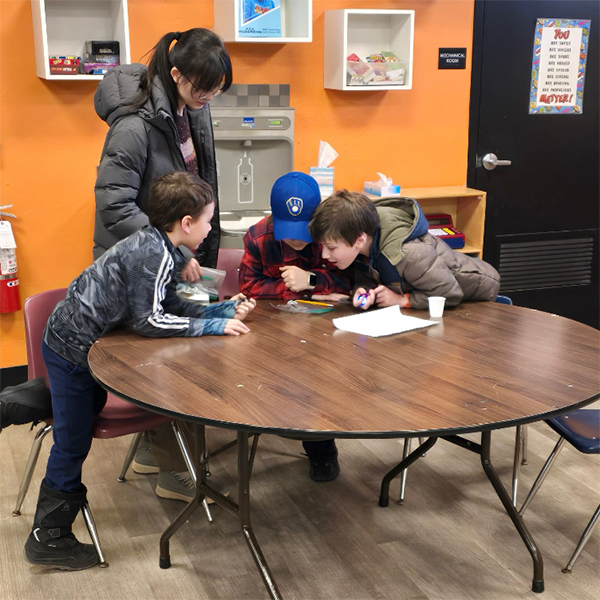
In this CBL course, students lead elementary school science clubs. In addition to planning activities, they focus on awareness of their own identities and community backgrounds as well as the importance of diversity in STEM so that they can actively engage with their students and community in a holistic way.
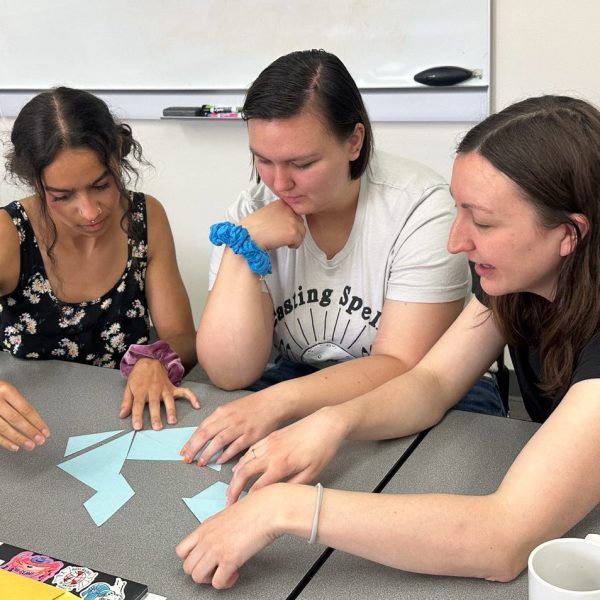
STEM Public Service Fellows Program
This program examines professional opportunities in STEM community engagement. It focuses on the scholarship of community-engaged work, best practices for connecting with the public, and developing a mutually beneficial project with a local community organization.
Sample Activities Using the Frameworks
Student activities can focus on individual components of the framework, a series of outcomes within a domain, or on the framework as a whole. Many can be easily scaled to different student levels.
Skills for Civic Life Activity
Variations on an activity that focuses on the “Develop the skills to participate in civic life” component of the framework with students’ personal experiences.
Audience: first-year students, undergraduates, and graduate students/post-doctoral fellows.
Personal Identity Activity
Activities connected to the “Develop awareness of personal identity” component of the framework with students’ personal experiences.
Audience: first-year students, undergraduates, and graduate students/post-doctoral fellows.
Reflective Activity
This is a broad reflection of the entire framework and is applicable for any CBL course. It was developed for Service with Youth in STEM (INTEGSCI 240) and includes two versions that are meant to highlight the students’ recognition of how their views of the framework components have changed over time.